


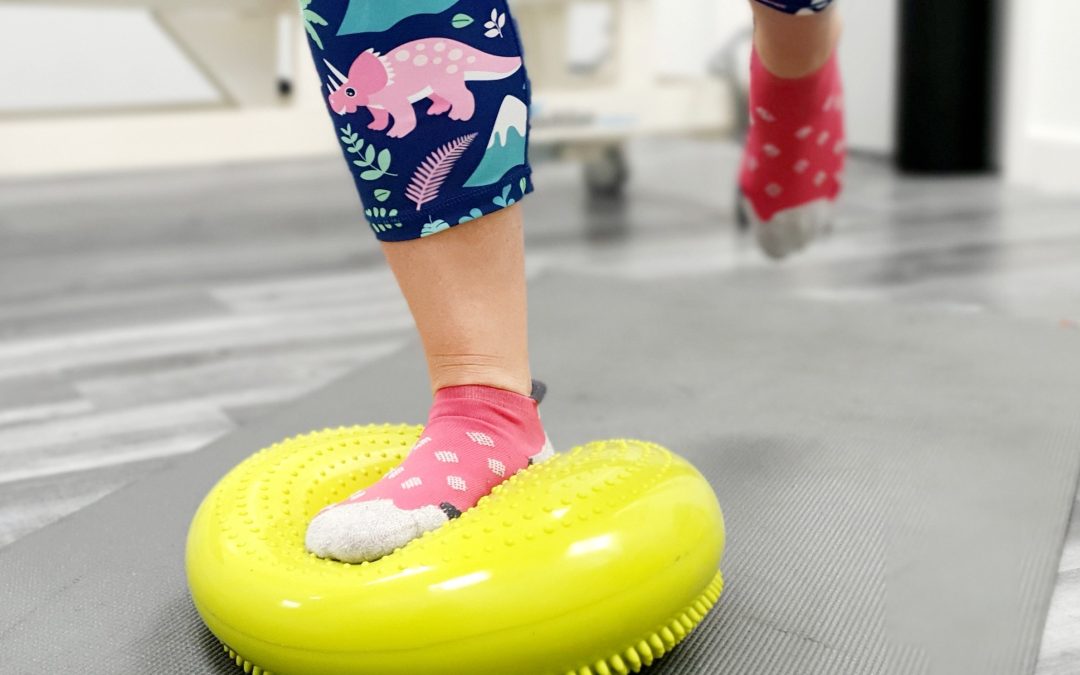
Balance exercises are something many people don’t think about, until their balance starts to feel a little off.
That might be a slight wobble when standing on one leg, a lack of confidence walking on uneven ground, or simply feeling less steady than you used to. For some, it shows up during sport or in the gym. For others, it becomes noticeable on walks around places like Calke Abbey or out in the Peak District.
The reality is that balance underpins almost everything we do physically. Improving it isn’t just about stability; it’s about performance, confidence and long-term health. At Vitalize Physiotherapy & Sports Injury Specialists, balance is something we assess and develop regularly as part of physiotherapy, rehabilitation and injury prevention.
Why Balance Matters More Than You Think
Balance is your body’s ability to stay controlled and stable, whether you are standing still, walking, turning or reacting to movement.
It relies on a combination of strength, coordination, joint control and proprioception—your body’s awareness of where it is in space. This system is supported by three key inputs:
- the visual system (what you see)
- the vestibular system (inner ear balance organs)
- and the somatosensory system (feedback from muscles and joints)
When these systems are working well together, movement feels smooth and controlled. When they are not, things can feel slower, less stable and more effortful. For active individuals and athletes, this has a direct impact on performance. Good balance allows for sharper reactions, better movement control and more efficient force production. It also plays a key role in load distribution through the lower limb. Without it, you are often compensating, which can increase the risk of injury—particularly around the ankles and knees, where poor control can lead to instability or overload.
Balance Beyond Sport
Balance isn’t just something that matters in a gym or on a pitch.
For many people locally in Ashby-de-la-Zouch and Swadlincote, staying active means getting out for walks; whether that’s around the National Forest, Calke Abbey or further afield into the Peak District. These environments naturally challenge your balance with uneven terrain, slopes and unpredictable surfaces.
From a clinical perspective, these situations require constant small adjustments through the ankle, knee and hip – often referred to as “postural control”. When this system is working well, these adjustments happen automatically. When it is reduced, the body becomes slower to react, which is where trips and stumbles are more likely to occur.
When your balance is good, you move with confidence. When it isn’t, even simple activities can feel less secure.
The Role of Balance in Falls Prevention
As we get older, there is a natural decline in strength, coordination and reaction time. Balance is often one of the first things to be affected. This is partly due to reduced muscle strength, slower neuromuscular responses and decreased proprioceptive input from joints.
Falls are one of the leading causes of injury and hospitalisation in older adults. What often follows is a gradual reduction in movement, confidence and independence. It can become a downward cycle—less movement leads to more weakness, which increases fall risk further.
From a rehabilitation perspective, this is why early intervention is so important. Strength and balance exercises can improve neuromuscular control, reaction time and joint stability, all of which contribute to reducing fall risk.
This is why balance and strength exercises are so important. They are one of the most effective ways to maintain stability, confidence and independence over time.
A Foundation for Movement at Any Age
One of the key things to understand is that balance is not just for older adults, and it is not just for athletes.
It sits at the foundation of all movement.
Whether you are:
• returning from injury
• trying to improve performance
• staying active with walking
• simply wanting to feel more stable day to day
Improving balance will support all of these. It also plays an important role in retraining movement patterns following injury, helping the body regain control and reduce the likelihood of recurrence.
The key is making sure exercises are appropriate for your level and done safely.
Simple Balance Exercises You Can Do at Home
These balance exercises are designed to be simple, effective and easy to incorporate into your routine. They should feel controlled rather than rushed, and you should always have something nearby for support if needed:
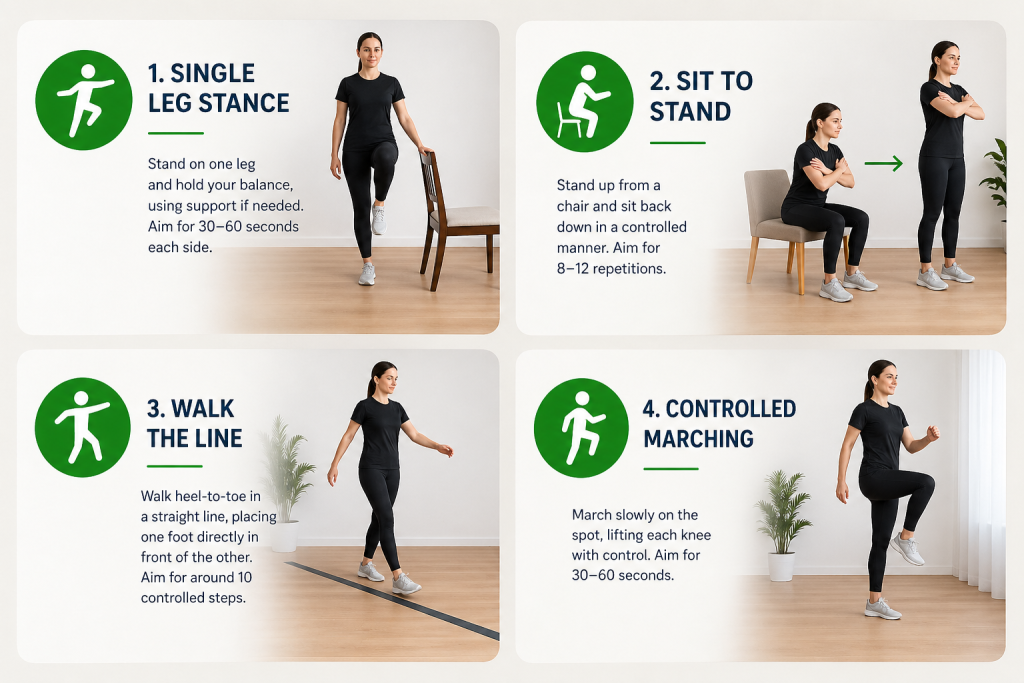
Single Leg Stance:
This is one of the simplest and most effective ways to challenge your balance. Standing on one leg encourages your body to stabilise through the ankle, knee and hip while engaging your core and smaller stabilising muscles.
Aim to hold for 30–60 seconds on each side. Focus on staying upright and controlled rather than just “getting through” the time. If it feels too easy, reducing hand support or closing your eyes can increase the challenge, provided it is safe to do so. Removing visual input forces the body to rely more heavily on proprioception.
Sit to Stand:
This is a very functional movement that directly transfers into everyday life. Standing up from a chair and sitting back down with control helps build strength and coordination through the lower body, particularly through the quadriceps and gluteal muscles.
Aim for 8–12 repetitions, keeping the movement steady. Reducing the use of your hands increases the challenge and encourages better lower limb control.
Walk the Line:
This exercise challenges your balance during movement. Walking heel-to-toe in a straight line requires coordination, control and postural stability.
Take around 10 slow, deliberate steps, maintaining an upright posture. Having a wall or surface nearby for support is useful if needed. This type of exercise helps improve dynamic balance, which is particularly relevant for walking on uneven ground.
Controlled Marching:
Slow marching on the spot introduces balance in a more dynamic way. Lifting each knee with control forces your body to stabilise repeatedly on one leg, improving single-leg control and coordination.
Aim for 30–60 seconds, focusing on control and posture rather than speed.
When Balance Needs More Than Home Exercises
For many people, these exercises are a great starting point. However, if balance is affecting confidence, walking ability or activity levels, a more tailored approach is often needed.
This is particularly relevant if there has been:
• a previous fall or near fall
• ongoing joint pain
• a recent injury
• repeated ankle or knee issues
• reduced confidence during movement
In these situations, balance issues are often linked to underlying factors such as strength deficits, reduced joint mobility or altered movement patterns. At Vitalize Physiotherapy & Sports Injury Specialists, we assess balance as part of a wider picture: looking at strength, movement patterns, mobility and injury history. From there, we build structured rehabilitation or exercise programmes that are specific to the individual.
Building Confidence Through Better Balance
Balance is often overlooked, but it plays a central role in how we move, perform and stay active.
From improving control in sport, to walking confidently on uneven ground, to reducing the risk of falls later in life, it provides a foundation that everything else builds on.
With the right approach, it is something that can be improved at any age!
Vitalize Physiotherapy & Sports Injury Specialists
Ashby-de-la-Zouch & Swadlincote
Physiotherapy | Sports Injury Rehabilitation | Injury Prevention
📞 07831 465179
✉️ info@vitalizephysiotherapy.co.uk
🌐 www.vitalizephysiotherapy.co.uk

Recent Comments